
|
| The exosphere is the highest and outermost layer of Earth's atmosphere, serving as the gradual boundary where our gaseous envelope thins out and merges with outer space. |
|---|
| What Drives Plate Motion | Plate Boundaries: The Three Types |
|---|---|
|
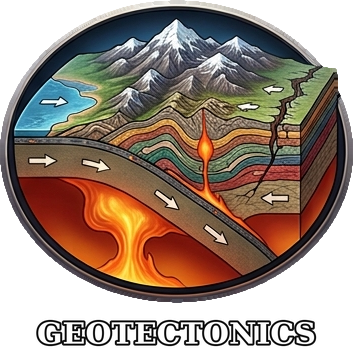
•- **Slab pull:** a cold, dense, subducting oceanic plate is denser than the asthenosphere it sinks into, and its own negative buoyancy pulls the rest of the attached plate along behind it — like a tablecloth being pulled off a table by its overhanging edge. Geodynamic modeling consistently finds this to be the dominant driving force for plates actively undergoing subduction.
•- **Trench suction:** a further, smaller effect in which the rollback of a subducting slab draws the overriding plate trenchward, contributing to back-arc extension in some subduction settings •- **Ridge push:** newly formed oceanic lithosphere at a mid-ocean ridge sits topographically high (it is hot and buoyant) and slides gravitationally away from the ridge crest as it cools and thickens with age — a smaller but still significant contributor. • - **Basal drag (mantle traction):** the flowing asthenosphere beneath a plate can either drag the plate along with it or resist its motion, depending on whether mantle flow and plate motion are aligned — this is the least well-constrained of the three, and its relative importance is still debated (a live illustration of the differential-motion picture in Section 11.4: plates do not simply ride passively on mantle flow, nor are they entirely self-propelled). |
• - **Divergent boundaries:** plates move apart, most prominently at mid-ocean ridges, where upwelling mantle material undergoes decompression melting (Section 3.6) to form new oceanic crust continuously — the process underlying seafloor spreading and, ultimately, the magnetic striping evidence for geomagnetic reversals described in Section 7.6. Continental rifting (e.g., the East African Rift) is the same process beginning within a continent, potentially the first stage of a new ocean basin opening.
•- **Convergent boundaries:** plates move toward each other, and the outcome depends on what kind of lithosphere is on each side. Where dense oceanic lithosphere meets less-dense continental or younger oceanic lithosphere, it is subducted — the surface expression of the slab-pull force discussed in Section 10.1. Where two continents collide, neither is dense enough to subduct efficiently, and the result is large-scale crustal thickening and mountain building (the Himalaya, from the ongoing India–Asia collision, is the standard example) — a direct, large-scale expression of isostasy (Section 9.2), since the resulting mountains require correspondingly deep crustal roots to remain buoyantly supported. • **Transform boundaries:** plates slide past one another laterally with no net creation or destruction of lithosphere, producing intense shallow seismicity but comparatively little volcanism — California's San Andreas Fault is the standard example. Transform faults are also the mechanism that accommodates the offset, stair-step geometry of mid-ocean ridge segments. |
 Back |